

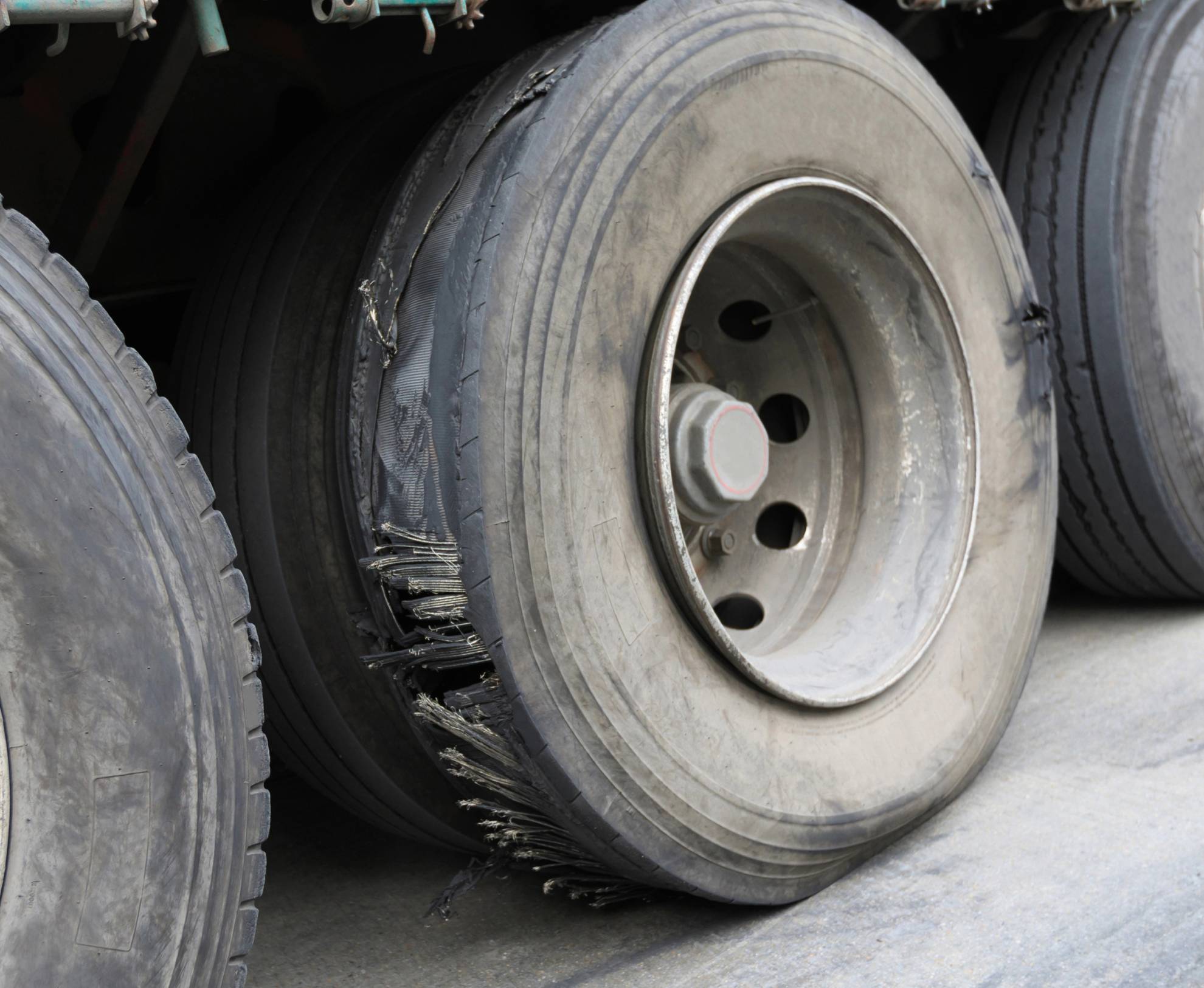
Michigan does not use one single statute for every tire-related offense. Instead, several provisions of the Michigan Vehicle Code may apply depending on the condition of the tire:
ℹ️ Insufficient Tread Depth – MCL 257.710a
Michigan requires most vehicles, including commercial vehicles operating within the state, to have tires with:
- At least 2/32 inch of tread depth in any two adjacent tread grooves on the primary grooves of the tire.
A violation of MCL 257.710a is a civil infraction.
ℹ️ Unsafe Equipment – MCL 257.683
If a tire is in a condition that makes the vehicle unsafe — for example:
- Exposed cords
- Tire separating
- “Maypop” conditions
An officer may issue a citation under MCL 257.683 for operating an unsafe vehicle. This is also typically charged as a civil infraction unless the equipment defect rises to a level where the officer deems the vehicle unsafe to operate.
📘 Federal Regulations for CMVs
For CDL drivers, the Michigan State Police Commercial Vehicle Enforcement Division enforces federal tire standards during roadside inspections. These come from 49 CFR § 393.75, which prohibits:
- Tread depth less than 4/32 inch on steering axle tires of a CMV.
- Tread depth less than 2/32 inch on other tires.
- Any tire with sidewall or tread separation, exposed fabric, leaks, or improper repairs.
A violation of these federal rules may result in:
- FMCSA CSA severity points (tire violations range from 3–8 points depending on the violation).
- Possible out-of-service placement if the tire condition meets out-of-service criteria under the Commercial Vehicle Safety Alliance (CVSA) guidelines.
Local police departments, including the Taylor Police Department, can stop a CMV for equipment violations, but most commercial inspections in the Taylor area are performed by MSP or motor carrier officers.
🚚 Common Scenarios Leading to a Tire Violation in Taylor
- Roadside inspections along I-94, Telegraph, or Eureka Road where the officer checks tread depth with a gauge.
- A visible safety defect observed by an officer — bulge, exposed steel, tread separation, or a flat spot from a locked brake.
- A post-crash equipment check following a minor collision.
- A weigh station or mobile inspection that uncovers a DOT-level tire defect.
For CDL drivers, these violations often arise from mechanical or maintenance issues outside the driver’s control, but the driver still carries compliance responsibility under FMCSA rules.
🧾 Classification and Legal Consequences for Non-CDL Drivers
For a non-commercial motorist, a tire violation under MCL 257.710a or 257.683:
- Is normally a civil infraction, not a misdemeanor.
- Is typically handled through the 34th District Court in Taylor.
- Usually does not involve driver’s license points unless the charge is rewritten to another moving violation (which is uncommon for equipment issues).
Courts often allow the driver to repair or replace the tire and show proof of correction. Some judges may consider a reduced fine when the defect is fixed promptly.
📊 CDL-Specific Consequences
Commercial drivers face additional layers of exposure beyond the state civil infraction:
📁 CSA / PSP Impact
A tire defect discovered during an inspection is uploaded into FMCSA’s Safety Measurement System and reported in the driver’s Pre-Employment Screening Program (PSP) file.
- Steering axle tread violations and flat or missing tires are high-severity CSA violations
- These remain visible on PSP reports for three years, affecting employability.
🛑 Out-of-Service Risk
Under CVSA out-of-service criteria, a commercial vehicle must be placed out of service for:
- Steering axle tires under 4/32 inch
- Other tires under 2/32 inch
- Sidewall damage exposing cords
- Tread or sidewall separation
- Audible leaks in air-filled tires
An out-of-service order impacts a driver’s record and can trigger employer discipline.
🏢 Employer and Insurance Consequences
Carriers often take tire violations seriously because:
- They raise the company’s CSA Vehicle Maintenance BASIC score.
- Insurance underwriting reviews tire violations as indicators of maintenance compliance issues.
- Some carriers impose internal penalties or mandatory retraining on drivers who receive equipment-related violations while under dispatch.
Even if the driver did not cause the defect, the violation still attaches to the driver through FMCSA’s reporting system.
⚖️ How Taylor and Wayne County Courts Commonly Handle This Violation
- Verify the defect has been corrected,
- Consider dismissal of the original charge or a reduction to a non-moving, lower-impact infraction, or
- Impose a standard civil fine if not corrected.
For CDL drivers, the key objective is preventing a judgment that leads to unnecessary employer scrutiny, insurance consequences, or negative CSA impact if the stop involved a DOT inspection.
While Michigan courts cannot remove an FMCSA record from a federal inspection report, they can control how the underlying state citation is resolved, which may influence how employers interpret the event.
🧭 Practical Next Steps for a Driver in Taylor
A driver who receives a tire violation in Taylor should:
- Document the tire condition immediately, including photos and repair invoices.
- Determine whether the stop involved a DOT inspection; if so, review the inspection report for accuracy.
- Address the defect promptly to avoid additional enforcement or a follow-up citation.
- Contact counsel experienced in Wayne County traffic defense, particularly a lawyer who regularly represents CDL operators. Tire violations are often negotiable, but only when presented properly to the prosecutor or magistrate.
- Appear or have counsel appear at the 34th District Court if required. Ignoring the ticket can result in additional sanctions.
A tire violation may look simple, but for a commercial driver, it can affect CSA scores, PSP records, and employment. Addressing the matter correctly from the start ensures the issue is contained and does not create long-term professional consequences.